How to Build Habits That Last: The Science of Behavior Change
Pop psychology has made habits seem simple. The behavioral science is more nuanced and, ultimately, more useful. This article draws on the research of Wendy Wood, BJ Fogg, James Clear, and Phillippa Lally to give you a grounded, evidence-informed approach to building learning habits that hold.

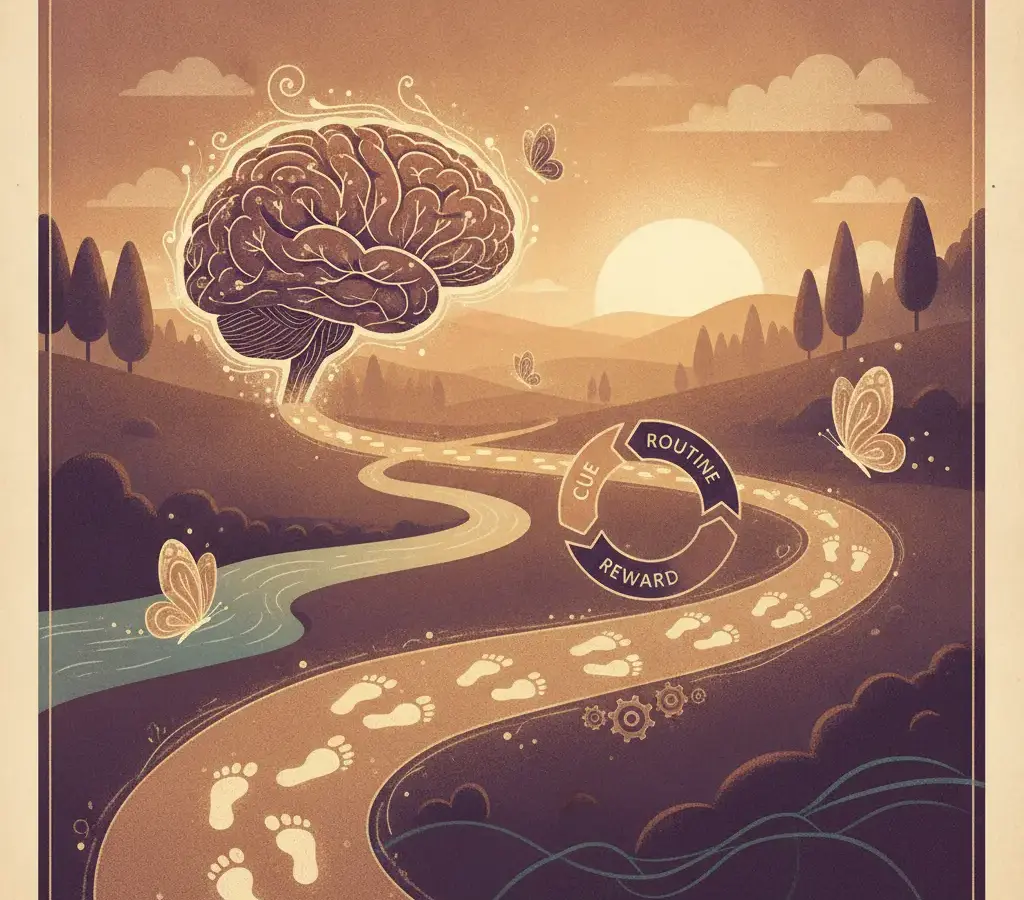
Lasting habits form when a behavior becomes automatic in response to a stable contextual cue—not when you rely on motivation or willpower. Research suggests habit formation takes an average of 66 days (not 21), that environment design is more powerful than intention, and that implementation intentions dramatically increase follow-through.
Key Takeaways
- Phillippa Lally's UCL study found habit formation takes an average of 66 days, with a range of 18–254 days—the 21-day myth has no scientific basis.
- Wendy Wood's research on context and habit shows that stable environments trigger automatic behavior more reliably than motivation; redesigning your environment is a more durable intervention than resolving to try harder.
- BJ Fogg's Tiny Habits method demonstrates that starting with very small behaviors anchored to existing routines reliably outperforms ambitious habit attempts that require high motivation to sustain.
- James Clear's concept of identity-based habits—defining yourself as a learner rather than trying to reach a learning goal—creates a motivational structure that is more robust to short-term setbacks.
- Habit stacking (linking a new behavior to an established anchor habit) is one of the most reliably effective implementation strategies in the applied literature.
Why Most Habit Advice Misses the Science
The personal development industry has built an enormous market around habits. Habit trackers, 30-day challenges, and bestselling frameworks proliferate. Much of this content is sincere and partly helpful. Very little of it is grounded in what behavioral science actually shows about how habits form and persist.
The most common myths: that habits form in 21 days (this figure has no scientific basis); that motivation is the driver of sustained behavior change (research suggests the opposite—motivation fluctuates and automatic context-cued behavior is far more durable); and that understanding why a habit is good for you will help you stick to it (knowledge rarely drives behavior change on its own).
The behavioral science on habits is more nuanced and ultimately more practical. This article focuses on four researchers whose work provides a rigorous foundation for anyone trying to build lasting learning habits.
The 66-Day Reality: Phillippa Lally’s Habit Formation Study
The most-cited scientific study on how long habit formation takes is Phillippa Lally’s 2010 study at University College London, published in the European Journal of Social Psychology. Lally and colleagues tracked 96 participants who were each trying to form a new daily health behavior. They measured automaticity—the degree to which the behavior felt effortless and automatic—over 84 days.
The finding: on average, participants reached plateau automaticity at 66 days. The range was 18 to 254 days, depending on the behavior complexity and the individual. The "21 days" figure that circulates in popular culture is attributed to a passage in Maxwell Maltz’s 1960 book Psycho-Cybernetics describing the minimum time for patients to adjust to physical changes—a context entirely unrelated to habit formation research.
For learners, the practical implication is important: if a new study habit does not feel automatic after three weeks, that is not a sign of personal failure. It is simply the reality of how habit formation works. Expecting automaticity too early leads people to conclude they are not habit-forming people, rather than that they are still in the formative phase.
Wendy Wood: Context, Not Willpower
Wendy Wood, a professor at the University of Southern California and author of "Good Habits, Bad Habits," has spent decades researching habit formation and change. Her central finding is one that habit self-help consistently underemphasizes: habits are fundamentally context-dependent.
In Wood’s framework, a habit is an automatic response to a contextual cue—a location, a time of day, a preceding action, a social context. When the context is stable, the behavior becomes automatic because the associative link between cue and behavior strengthens with repetition. When the context changes—you move to a new city, change jobs, change your daily routine—the contextual cues that triggered old habits disappear, and new behaviors become easier to establish. This explains the "fresh start effect" that researchers have observed around life transitions.
The design implication is powerful: instead of relying on motivation and willpower to override competing impulses, redesign your environment to make the contextual cues for desired behaviors stronger and more reliable. If you want to build a daily reading habit, the most effective intervention is not resolving to read more but choosing a specific location (your reading chair, a particular café), a specific time (right after coffee), and removing friction (book on the table, not on a shelf in another room). Wood’s research suggests this context engineering produces more durable behavior change than intention alone.
BJ Fogg: Tiny Habits and the Anchor Technique
BJ Fogg, director of the Behavior Design Lab at Stanford, proposes a framework that deliberately works against the grandiose ambition most people bring to habit formation. In his Tiny Habits method, reported in his 2019 book of the same name, Fogg argues that the most reliable route to new behavior is making the behavior small enough that motivation is rarely required—and anchoring it to an existing habit.
The anchor technique works like this: identify an existing habit you reliably perform every day (making coffee, brushing your teeth, sitting down at your desk). Immediately after that habit, perform a tiny version of the behavior you want to build. Want to build a habit of reviewing flashcards? After you sit down at your desk (the anchor), review three flashcards. Just three. The goal is not achievement; it is repetition of the cue-behavior pairing until it becomes automatic.
Fogg’s research, and the subsequent research citing his framework, consistently shows that starting very small and allowing the habit to grow organically outperforms setting ambitious targets and relying on motivation to meet them. The common failure mode of ambitious habit-setters is inconsistency: a missed day of a demanding habit is more psychologically disruptive than a missed day of a tiny habit, leading to abandonment rather than resumption.
James Clear: Identity-Based Habits
James Clear’s "Atomic Habits" (2018) is a popular synthesis of habit science, not original research, but it contains one genuinely useful conceptual contribution: the identity framing. Clear distinguishes between outcome-based habits ("I want to run a marathon") and identity-based habits ("I am a runner"). His argument is that identity framing creates a motivational structure more resilient to short-term setbacks because it ties individual behaviors to a self-concept rather than a discrete goal.
The behavioral science underpinning this is real. Research on self-concept and behavior consistency (from social psychologists including Aronson on cognitive dissonance) suggests that when people identify with a category ("I am a reader," "I am someone who exercises"), they are more likely to maintain associated behaviors because discontinuing them produces identity-level dissonance. A missed workout is a temporary setback for someone with a fitness goal; it is an identity inconsistency for someone who considers themselves an exerciser—and people are generally motivated to resolve identity inconsistencies.
For learners, this suggests a practical reframe: rather than "I am trying to learn Python," "I am a programmer who practices every day." The goal orientation and the identity orientation are compatible, but the identity orientation adds motivational scaffolding that persists through the inevitably inconsistent early weeks of habit formation.
Putting It Together: A Habit Design Protocol for Learners
Synthesizing these frameworks into a practical protocol:
- Define the anchor: Identify an existing daily habit. This is where your new learning habit will attach.
- Design the tiny behavior: What is the smallest version of the new habit that would still count? Five minutes of flashcard review, reading one page, watching one video lesson. Start there.
- Engineer the context: Remove friction—materials accessible, devices ready. Add a reliable cue—a visual trigger (notebook visible, app open on device).
- Adopt the identity: Describe yourself as a person who does this, not as someone trying to do it.
- Expect the 66-day timeline: Track consistency without judging automaticity in the first month. Automaticity is earned over time, not immediately.
For behavioral science applications to workplace learning, see our training and development section, which covers how these principles apply to organizational learning design.
Sources
- Lally et al. (2010) – How are habits formed: Modelling habit formation in the real world (European Journal of Social Psychology)
- Wood, W. (2019) – Good Habits, Bad Habits (Farrar, Straus and Giroux)
- Fogg, B.J. (2019) – Tiny Habits (Houghton Mifflin Harcourt)
- Duhigg, C. (2012) – The Power of Habit (Random House)
- Clear, J. (2018) – Atomic Habits (Penguin Random House)
Lisa Kim
Lisa Kim holds a Master's degree in Applied Psychology with a concentration in behavior change and motivation, and spent the earlier part of her career working as a research associate at a behavioral health consultancy where she helped organizations design nudge-based interventions… Read full profile →
Frequently Asked Questions
Smarter learning, in your inbox
Get new vaeyc articles, AI tools, and career-growth tips weekly. Free.