Deep Work and Focus: A Practical Guide to Concentrated Learning
The ability to focus deeply on cognitively demanding material is both increasingly rare and increasingly valuable. This guide draws on Cal Newport's deep work framework and attentional research to give learners a practical system for concentrated study in a distracted environment.

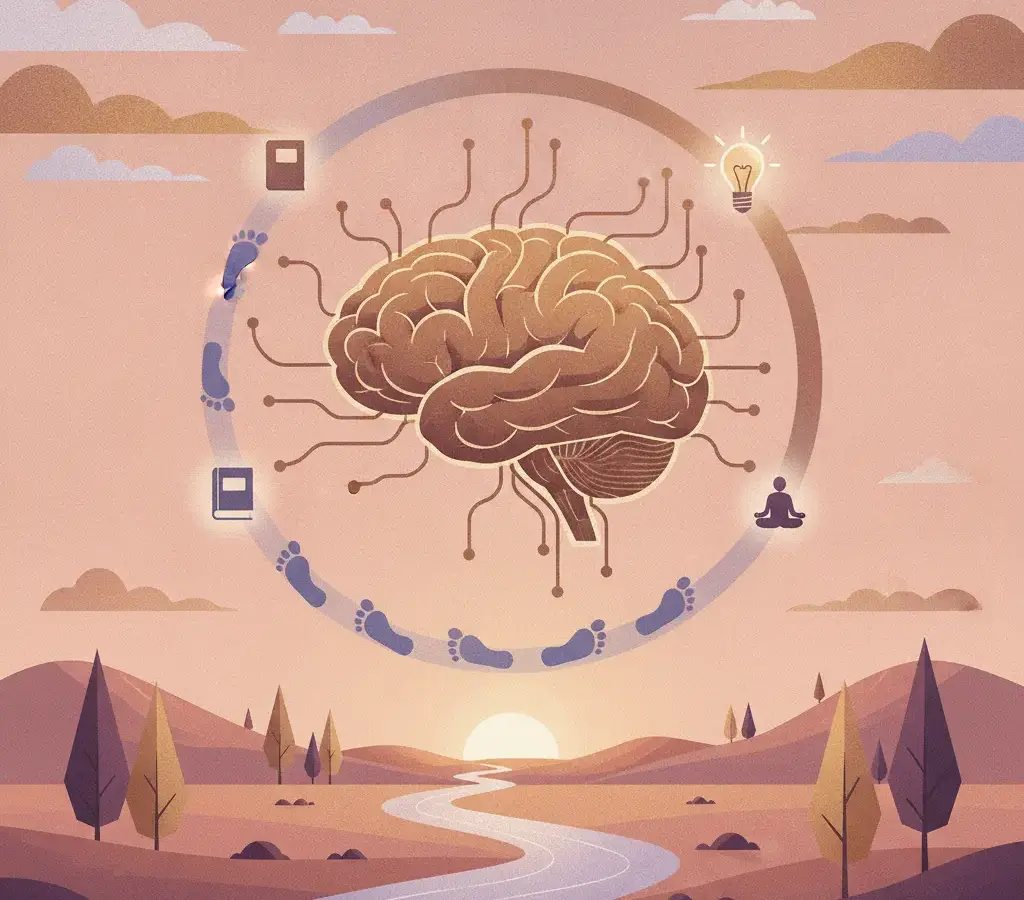
Deep work—cognitively demanding, distraction-free concentration—is the condition under which complex skill acquisition happens. The research on attentional switching shows that multitasking and shallow work create cognitive residue that reduces performance for hours after. Building regular deep work sessions, protecting them from interruption, and training attentional capacity are the core practices.
Key Takeaways
- Cal Newport's deep work framework distinguishes between deep work (cognitively demanding, distraction-free) and shallow work (logistical, interruptible)—and argues that depth is where most professional and academic value is created.
- Attentional residue research (Sophie Leroy, University of Washington) shows that switching between tasks leaves cognitive residue that impairs performance on the subsequent task for measurable periods.
- The distraction-free session length that maximizes learning efficiency is debated, but evidence points to 90-minute blocks aligned with ultradian rhythms as a well-supported target.
- Physical environment, digital environment, and ritual all contribute to the depth of focus achieved—each element is worth designing deliberately.
- Deep focus is a trainable capacity, not a fixed trait; attentional research suggests regular deep work practice builds the neural conditions for sustained concentration over time.
Why Deep Work Has Become a Rare Skill
In his 2016 book "Deep Work: Rules for Focused Success in a Distracted World," Cal Newport made a claim that is now more clearly true than when he made it: the ability to concentrate deeply on cognitively demanding work is becoming simultaneously rarer and more economically valuable. The knowledge economy rewards the ability to master complex skills and produce high-quality work quickly. Both of these depend on sustained, focused attention.
The reason depth is becoming rarer is documented: the average knowledge worker’s day is increasingly fragmented by communications infrastructure designed to demand immediate response. A 2023 study by Microsoft Research found that the average worker switches tasks or applications roughly once every forty seconds during active working hours. Whether or not this specific finding generalizes, the pattern it describes is familiar to anyone who has tried to study in the presence of an active email inbox, social media notifications, and an always-connected device.
Newport’s framework, the attentional science underlying it, and the practical strategies for implementing deep work are the subject of this guide.
Newport’s Deep Work Framework
Newport defines deep work as "professional activities performed in a state of distraction-free concentration that push your cognitive capabilities to their limit." He contrasts this with shallow work—logistical, cognitively undemanding tasks that are typically performed while distracted (email responses, administrative tasks, meetings that could be memos).
The core argument is that deep work is the mechanism by which complex skills are acquired and difficult intellectual problems are solved. Newport draws on deliberate practice research (Anders Ericsson’s work on expertise) to argue that focused, effortful engagement with demanding material is the condition under which cognitive circuits strengthen and new capabilities develop. This is not controversial within cognitive science.
What Newport adds beyond the research is a practical philosophy of structuring work and learning life around the protection of deep work time. He describes four scheduling philosophies—monastic (extreme depth, minimal shallow work), bimodal (alternating deep and shallow periods), rhythmic (scheduled daily deep work blocks), and journalistic (seizing deep work windows whenever they appear)—and argues that the rhythmic model is most accessible for most people: a consistent daily deep work block, protected by habit and ritual.
The Science of Attentional Residue
One of the most practically significant pieces of attentional research for learners is Sophie Leroy’s concept of attentional residue, published in Organizational Behavior and Human Decision Processes in 2009. Leroy’s experiments demonstrated that when people switch from one task to another before fully completing the first, part of their attention remains with the unfinished task. This residue impairs performance on the new task for a measurable period—the effect was observed even when participants switched tasks voluntarily and believed they had mentally disengaged from the first task.
The implication for study sessions is direct: fragmented study—ten minutes of reading, a text message response, back to reading—is not equivalent to thirty continuous minutes of reading, even though the clock time is the same. The switching creates cognitive residue that reduces the quality of the attention available for the learning material. This is one mechanism by which phone-present study environments produce worse learning outcomes than phone-absent ones, independent of the time actively spent on the phone.
Research at the University of Texas Austin (Ward et al., 2017) found that the mere presence of a smartphone on the desk—even face-down and silent—reduced available cognitive capacity compared to conditions where the phone was in another room. This effect was stronger for participants who reported higher smartphone dependence, but was present across the sample. The attentional cost of keeping a device visible during focused study is not zero.
Building a Deep Work Practice
The practices that support deep work are well-established in the literature and the practical writing on the topic. The challenge is not understanding them; it is implementing them against the grain of an environment designed for shallow engagement. Here is a systematic approach:
Schedule deep work blocks explicitly. Deep work does not happen in the gaps between other activities. It requires protected time on the calendar, treated as a commitment equivalent to a meeting. The rhythmic model suggests a consistent daily time—for many learners, the early morning before communications infrastructure fully activates is the easiest window to protect.
Design a deep work ritual. Newport describes rituals as a way of pre-loading the conditions for depth so that the transition into focus is automatic rather than effortful. A ritual might include: a specific location, a preparation routine (close all applications except the one needed, put the phone in another room, make coffee), and a defined goal for the session ("I will complete the first draft of this analysis" rather than "I will work on this for two hours"). Research on implementation intentions suggests that specifying the exact conditions and goals of a planned activity significantly increases follow-through.
Work in blocks aligned with attentional capacity. The evidence on optimal work-session length points toward 90-minute blocks as a reasonable target, reflecting ultradian rhythm research by Peretz Lavie and others showing that the human performance cycle follows roughly 90-minute oscillations between higher and lower alertness. A 90-minute focused session followed by a genuine break (not a phone check) aligns with biological rhythms rather than working against them.
Train attentional capacity deliberately. Newport argues, consistent with cognitive research, that deep focus is a trainable capacity. Regular exposure to boredom without reaching for distraction—what Newport calls "embracing boredom"—strengthens the attentional circuits that focused work requires. Practices like single-task engagement during otherwise idle moments (walking, commuting, waiting) without devices appear to maintain attentional capacity against the erosion that constant device use produces.
Application to Learning Specifically
For learners, deep work is the condition under which complex material is actually absorbed and integrated—not merely encountered. The neuroscience of memory consolidation suggests that this requires effortful engagement (the testing effect, where retrieval practice strengthens memory) and adequate spacing (the spacing effect, where distributed practice over time is more effective than massed practice). Both of these require the attentional depth that shallow, fragmented study cannot produce.
A practical study session design: a 90-minute deep work block, phone in another room, single application open, with a session goal (reach a specific point in the material, complete a problem set, finish a draft). Followed by a 20-minute break before deciding whether to begin another block. This structure is more demanding than typical study habits and produces meaningfully better outcomes per hour invested.
For the broader behavioral science of learning, see our habits and behavior change articles. For tools that can support focused self-directed study, see our AI learning resources.
Sources
- Newport, C. (2016) – Deep Work: Rules for Focused Success in a Distracted World (Grand Central Publishing)
- Leroy, S. (2009) – Why is it so hard to do my work? The challenge of attention residue when switching between work tasks (Organizational Behavior and Human Decision Processes)
- Ward et al. (2017) – Brain Drain: The Mere Presence of One's Own Smartphone Reduces Available Cognitive Capacity (Journal of the Association for Consumer Research)
- Ericsson, K.A. et al. (1993) – The Role of Deliberate Practice in the Acquisition of Expert Performance (Psychological Review)
Lisa Kim
Lisa Kim holds a Master's degree in Applied Psychology with a concentration in behavior change and motivation, and spent the earlier part of her career working as a research associate at a behavioral health consultancy where she helped organizations design nudge-based interventions… Read full profile →
Frequently Asked Questions
Smarter learning, in your inbox
Get new vaeyc articles, AI tools, and career-growth tips weekly. Free.