Master Lasting Change: Behavioral Strategies That Actually Work
Most behavior change efforts fail within weeks — not because of lack of willpower but because of fundamental mismatches between how change is designed and how human behavior actually works. Drawing on BJ Fogg's Tiny Habits research, James Clear's Atomic Habits framework, Charles Duhigg's habit loop model, and Wendy Wood's habit science, this guide presents the strategies with the strongest evidence for lasting change.


Lasting behavior change requires three things working together: a cue that reliably triggers the behavior, a routine that is small enough to do even on your worst day, and a reward that occurs immediately after. Start with the smallest possible version of the behavior — BJ Fogg calls this a "Tiny Habit" — and scale only after the behavior becomes automatic.
Key Takeaways
- The "motivation is the problem" framing is almost always wrong — most behavior change failures are design failures, not character failures.
- BJ Fogg's research at Stanford shows that making a behavior smaller (not more motivating) is the most reliable path to habit formation.
- James Clear's identity-based framing — "I am a runner" rather than "I want to run" — shifts the psychological basis of behavior from goal-orientation to self-concept, which research shows is more durable.
- Wendy Wood's research demonstrates that approximately 43% of daily actions are habits — automatic behaviors triggered by context rather than deliberate decisions.
- Implementation intentions ("I will do X when Y happens") double follow-through rates compared to goal intentions in Gollwitzer's research.
Why Willpower Is the Wrong Mental Model for Change
The dominant cultural narrative about behavior change runs as follows: you want to change, you decide to change, you summon the motivation and willpower to change, and — if you fail — it is because your motivation or willpower was insufficient. This model is flatly contradicted by behavioral science.
The research is clear: willpower is a limited resource that depletes with use (Roy Baumeister’s ego depletion research), is highly sensitive to sleep, nutrition, and stress, and is not the primary driver of habitual behavior even when abundant. More importantly, the behaviors most people want to change — diet, exercise, study habits, productivity routines — are by definition habitual behaviors. And habits, as Wendy Wood’s research at USC demonstrates, operate largely outside deliberate decision-making entirely.
Designing behavior change through motivation and willpower is trying to solve a context and cue problem with a mental resource that isn’t actually involved in the process. This guide presents the frameworks that address the actual mechanisms.
The Habit Loop: Duhigg’s Foundation
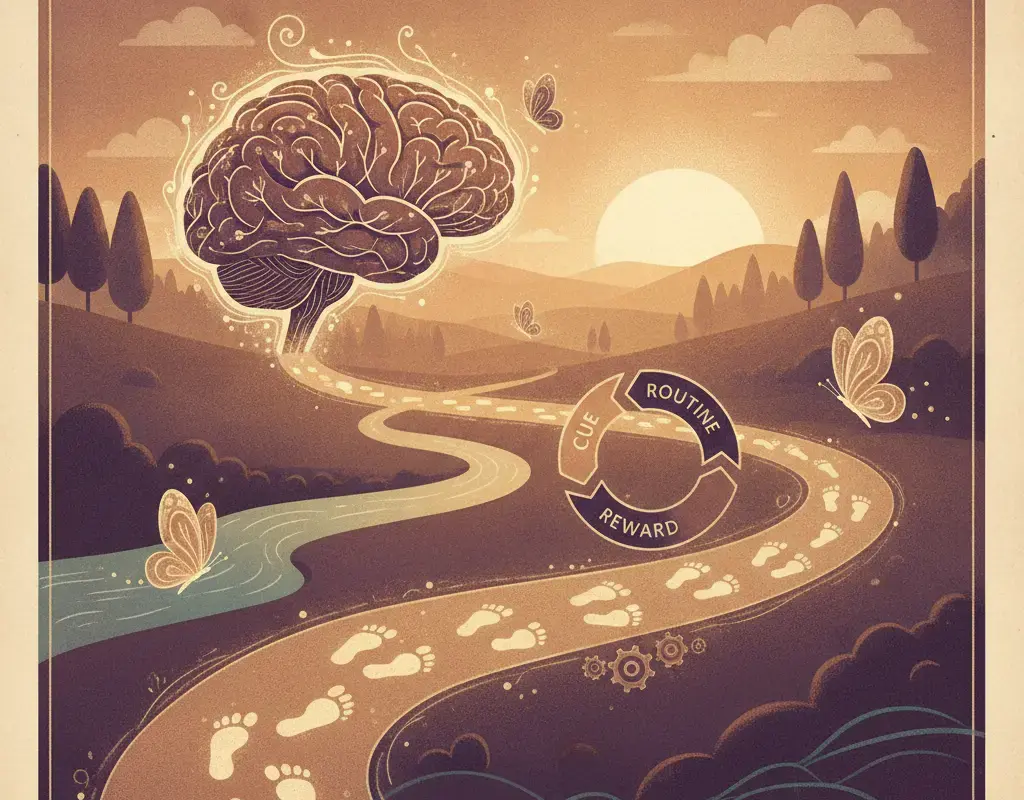
In The Power of Habit (2012), journalist and researcher Charles Duhigg synthesized decades of behavioral research — particularly the work of Ann Graybiel at MIT’s McGovern Institute — into a three-part model: cue → routine → reward. The cue triggers the behavior automatically, the routine is the behavior itself, and the reward reinforces the loop for future repetition.
Duhigg’s practical contribution was demonstrating that habits can be changed by keeping the cue and reward constant while substituting the routine. Smokers who use cigarettes as a stress-relief routine (cue: stress; reward: mood shift and social moment) can disrupt the habit by identifying what reward they are actually seeking and finding a different routine that provides it. This “habit substitution” approach is supported by clinical behavior change literature and is widely used in addiction treatment.
The model’s limitation is that it is better at describing existing habits than designing new ones. For that, more targeted frameworks are needed.
BJ Fogg and Tiny Habits: The Smallest Possible Start
BJ Fogg, a behavioral scientist at Stanford and founder of the Behavior Design Lab, has spent two decades studying what actually creates lasting behavior change. His central finding — articulated in Tiny Habits (2019) and dozens of peer-reviewed papers — is counterintuitive: behavior change fails when we start too big, not too small.
Fogg’s Behavior Model (B=MAP) states that a behavior occurs when Motivation, Ability, and a Prompt align at the same moment. The insight is that motivation fluctuates — often unpredictably — but ability can be engineered to remain constant if the behavior is small enough. A “Tiny Habit” is designed to be so small that you can execute it on your lowest-motivation day without any additional willpower: “After I pour my morning coffee, I will open my language learning app and complete one exercise.” Two minutes. Non-negotiable. Always executable.
The mechanism is not that tiny habits stay tiny — they don’t. It’s that executing a small behavior consistently creates the neurological and psychological conditions (the cue-routine-reward association, the identity reinforcement, the success spiral) that allow the behavior to grow. Research from Fogg’s lab and replications elsewhere consistently shows that downsizing a desired behavior dramatically increases adoption rates and reduces dropout.
James Clear and Atomic Habits: Identity-Based Change
James Clear’s Atomic Habits (2018) brought behavioral science to a mass audience with clarity and practicality. Its most distinctive contribution is the argument for identity-based habit formation: rather than framing change as “I want to exercise more,” frame it as “I am becoming someone who prioritizes physical health.” Each action then becomes a vote for the desired identity, not an execution of a goal.
This reframing has behavioral science support. Research on self-concept consistency (Swann’s self-verification theory) shows that people are motivated to act in accordance with their self-image, even when the behavior is costly. By attaching the desired behavior to identity rather than outcome, the motivation source becomes more durable — less dependent on specific results, more dependent on the stable desire to act consistently with one’s self-concept.
Clear’s four laws of behavior change — make it obvious (cue design), make it attractive (reward anticipation), make it easy (friction reduction), make it satisfying (immediate reward) — are a practical reformulation of Fogg and Duhigg’s models, and are useful as a design checklist for any new habit you are trying to install.
Wendy Wood and the Science of Automaticity
Wendy Wood’s research at USC (summarized in Good Habits, Bad Habits, 2019) provides the most rigorous academic grounding for the popular frameworks. Her key finding from habit research: approximately 43% of our daily behaviors are performed habitually — automatically, without deliberate thought, triggered by environmental context. This means most of what we do each day is not the result of conscious decision-making at all.
Wood’s practical implication is the concept of context engineering: because habits are triggered by environmental cues, changing the environment can change behavior more reliably than changing intentions. If you want to exercise more, lay out your workout clothes the night before (reduce friction), schedule workouts at the same time in the same location (create a consistent context cue), and remove alternatives (if the TV remote requires effort to find, you are more likely to exercise instead).
This is the behavioral mechanism behind the popular advice to change your environment rather than your motivation — and it has substantial experimental support, including Wood’s own studies showing that context disruptions (moving to a new city, starting a new job) produce larger habit change than motivational interventions in stable environments.
Implementation Intentions: Gollwitzer’s Contribution
Peter Gollwitzer’s research at NYU on implementation intentions provides one of the most actionable and evidence-supported behavior change tools available. An implementation intention is a specific plan: “When X happens, I will do Y.” Unlike a goal intention (“I will exercise more”), an implementation intention specifies the exact context cue and the exact behavior.
A 2006 meta-analysis of 94 studies by Gollwitzer and Sheeran found that implementation intentions doubled goal attainment rates across a wide variety of behavior change domains — exercise, diet, medication adherence, voting, and academic performance. The mechanism is that implementation intentions link the desired behavior to an existing environmental cue, essentially pre-programming the decision and reducing the cognitive load of acting in the moment.
The practical application is straightforward: for any behavior you want to adopt, complete this sentence: “When [specific situation/time/place/preceding action], I will [specific behavior].” Research consistently shows this formulation is more effective than any amount of motivational self-talk. For more on applying behavioral science to learning specifically, see our guide on online learning strategies and the research on habit formation in the behavioral science category.
Putting It Together: A Framework for Lasting Change
- Name the specific behavior, not the goal. “Write 200 words each morning” not “become a writer.”
- Make it tiny enough to be non-negotiable. Fogg’s test: can you do this on your worst day? If not, make it smaller.
- Anchor it to an existing behavior (habit stacking). “After I [existing anchor], I will [new habit].”
- Design the environment to make it easy. Reduce friction, increase visibility of the cue, remove competing behaviors.
- Celebrate immediately. Fogg’s research shows that immediate positive emotion — a genuine “yes!” or fist pump — accelerates habit formation. It must be genuine and immediate, not a promised future reward.
- Expect friction and plan for recovery. Missing one day doesn’t break a habit; missing two days in a row begins to.
Sources
- BJ Fogg — Tiny Habits: The Small Changes That Change Everything (2019)
- James Clear — Atomic Habits (2018)
- Wendy Wood — Good Habits, Bad Habits: The Science of Making Positive Changes (2019)
- Gollwitzer & Sheeran (2006) — Implementation Intentions Meta-Analysis, Advances in Experimental Social Psychology
- Wood, Quinn & Kashy (2002) — Habits in Everyday Life, Journal of Personality and Social Psychology
Lisa Kim
Lisa Kim holds a Master's degree in Applied Psychology with a concentration in behavior change and motivation, and spent the earlier part of her career working as a research associate at a behavioral health consultancy where she helped organizations design nudge-based interventions… Read full profile →
Frequently Asked Questions
Smarter learning, in your inbox
Get new vaeyc articles, AI tools, and career-growth tips weekly. Free.